The Stats
Slovenia has quite a rich, vivid and diverse performing arts scene, especially given its relatively small population of just over 2 million (precisely, 2,135,107 reported in Jan. 2026, Statistical Office of the Republic of Slovenia/SURS). The theatre scene currently consists of eleven theatre institutions (for spoken/drama theatre): three of which are state-funded or so-called Slovenian National Theatres; the remaining eight are defined as City Theatres (the number also includes the Slovenian Permanent Theatre in Trieste, now in Italy). In addition to those eleven, a diverse “off scene” comprising non-governmental organisations (NGOs) active in professional performing arts, e.g., producers, networks, festivals, etc., needs to be mentioned, most of whom are centralised in Ljubljana, Slovenia’s capital. To this lively activity, we can add two opera and ballet houses and two puppet theatres, the vibrant, yet only partially institutionalised, contemporary dance scene, followed by various mixed formats, such as street theatre, cabaret, circus, etc., each with its accompanying festival.
Data from the Slovenian Theatre Annual for the 2023/24 season reveals that 828,534 visitors attended performances across all theatre genres. Of the 501 productions in the repertoires of professional theatres that season, 280 were based on Slovenian texts or concepts and 221 on foreign ones.
Education in the field of theatre in Slovenia is, in most cases, provided by the Academy of Theatre, Radio, Film and Television at the University of Ljubljana, covering various study programmes, such as theatre directing, stage acting, dramaturgy, but also covering other media, such as film, television, radio, speech, scene design and movement.
The Prešeren Theatre Kranj, which is part of the DoSEL network, was established in 1945 (in 2025 it celebrated its 80th anniversary). By definition, it is a “City Theatre”, located in Kranj – in the northwestern region of Slovenia, with proximity to Austria and Italy – and is one of the smaller theatres in size (by number of employees and ensemble members), but one of the more visible ones (by the number of accolades and its politically daring and progressive repertory programme).
The Week of Slovenian Drama
Since 1971, the Prešeren Theatre Kranj has also been the sole host and organiser of the Week of Slovenian Drama. This all-Slovenian festival encourages and promotes original Slovenian playwriting and its staging. This year’s festival took place between 27 March and 11 April 2026 and marked the 56th consecutive edition.
According to the statistics for the 56th Week of Slovenian Drama, 64 new productions were staged in 2025 based on original Slovenian texts. Fifty-three new texts were sent in for the competition for the Slavko Grum Award for the Best New Slovenian Play (13 of those for the Zofka Kveder Award for the Best Young Playwright).
The current development in Slovenian theatre and playwriting still shows a rise in the so-called devised theatre trend, formats of collective collaboration and documentary theatre, whose focal points are usually engaged political topics: the environmental crisis, war conflicts, the capitalist exploitation of the labour force, (female) reproductive rights, the privatisation of public space, the real-estate market, etc. Only rarely are productions based on an actual pre-written Slovenian play, be it a contemporary play or an adaptation of one of the classics (in about 17 per cent of cases).
With limited possibilities for staging, a small number of publications, sparse possibilities of financial awards and scholarships, as well as residencies, and also due to the liminal status of drama in the field of literature and the bureaucratically unregulated and undefined status of drama (as well as playwrights), most (of the young but also mature) playwrights in Slovenia are struggling to persevere. In question is not so much a one-time breakthrough or a successful debut but the consistent development and continuous support of playwriting.
Albeit rare, financial awards in the field of playwriting are often seen as a supplement and compensation for non-existent social correctives. Apart from the Slavko Grum Award for the Best New Slovenian Play and the Zofka Kveder Award for Best Young Playwright, both bestowed by the Week of Slovenian Drama, the only other award is the biennial Gracious Comedy Quill Award for best comedy, presented by the Days of Comedy festival in Celje.
Historical Facts and Beginnings of Slovenian Drama: Between Religion and Comedy in the Age of Baroque and Enlightenment
The first play written and preserved in the Slovenian language to this day is the Škofjeloški pasijon or Processio Locopolitana (The Škofja Loka Passion Play) by the Capuchin friar Father Romuald, aka Lovrenc Marušič (1676–1748). Staged for the first time in 1721, it comes from a long medieval tradition of liturgical plays or live processions through the city. It depicts 13 scenes or tableaux from the Old and New Testaments.
Fun fact 1 – Passion: The director’s book for The Škofja Loka Passion Play is considered the oldest surviving book of stage directions in Europe.
Fun fact 2 – Passion: The Škofja Loka Passion Play is still staged to this day as a massive community-based live spectacle involving roughly 900 performers, moving through the old city of Škofja Loka (after which the procession bears its name). It is staged every six years, in the time of Lent between Ash Wednesday and Easter. The most recent performance was staged in 2026. Since 2016, The Škofja Loka Passion Play has been inscribed on the UNESCO Representative List of the Intangible Cultural Heritage of Humanity.
Fun fact 3 – Passion: The Škofja Loka Passion Play was staged in 2020 by the Prešeren Theatre Kranj as a professional theatre chamber piece and received the main awards at the biggest national festivals.
Another important milestone and the first secular Slovenian “drama” is represented by the comedy, Županova Micka (Micka/Molly, the Mayor’s Daughter), written by Anton Tomaž Linhart (1756–1795) and first staged in Ljubljana in 1789. The initial inspiration for the play was Die Feldmühle, a play by Austrian playwright Joseph Richter.
Fun fact 4 – Micka: The Prešeren Theatre Kranj staged Županova Micka in 2001 (dir. V. Taufer), which is very much alive to this day and still possible to see. It celebrated its 25th anniversary and 322nd performance in May 2026.
Two Prominent Slovenian Classical Playwrights: Ivan Cankar (1876–1918) and Slavko Grum (1901–1949)
The Week of Slovenian Drama acknowledges the best new original Slovenian play with an award named after Slavko Grum, the author of one of the most recognisable Slovenian plays, An Event in the Town of Goga (1928–1929), known for capturing an uneventful, yet stiflingly claustrophobic and troublesomely perverse atmosphere of a small city, typical for a small-scale environment, so (un)like Slovenia.
Fun fact 5 – Grum: Grum got the idea for his play at the mental hospital where he was working at the time.
Ivan Cankar, “the Father of Slovenian Drama” or “the East-European Ibsen”, is the other prominent Slovenian playwright, remaining one of the most staged to this day. This socially and politically engaged author with vast literary activity that spans from Symbolism and Naturalism and encompasses erotic poetry, social and autobiographical novels and boasts his stylistic and genre versatility, particularly in playwriting, which ranges from political satire and comedy, tragedy/drama and farce to static poetic images.
Fun fact 6 – Cankar: In 2026, we commemorate 150 years since the birth of Ivan Cankar. His best-known plays, especially the political ones that helped to shape the intrinsic perspective on the servile Slovenian national character and its corrupt political elites, were written or conceptualised in Vienna, where the author spent roughly ten years during the time when Slovenia was part of the Austro-Hungarian Empire (For the Good of the Nation, The Serfs/Lackeys).
Times of Socialism: Between Political Theatre, Drama of the Absurd and Poetic Drama (1945–1991)
During Slovenia’s socialist era, three types of playwriting prevailed: straightforward political drama, drama/theatre of the absurd and poetic drama. The reasons for the popularisation of the last two were (covert) political criticism of the socialist system, disguised in metaphors and humorous puns.
In the process, this period produced classics of Slovenian playwriting who, to this day, still count as masters of their craft: Dane Zajc, Gregor Strniša, Dominik Smole, Rudi Šeligo, Dušan Jovanović, Drago Jančar …
The Political Crisis of Playwriting after 1991 and the Question of the International Export of Slovenian Plays
Slovenia’s independence in 1991 sparked discussions about the deep crisis in Slovenian drama. Accusations from previous generations of writers were primarily political, claiming that, with the transition from socialism to democracy, playwriting as such had lost its political potency and relevance as well as its privileged position as a social critic. Apart from theatre’s struggle to compete for attention with more popular media, such as film, television and video games, audience-unfriendly experimentation within playwriting on the one hand and the popularity of postdramatic theatre (Hans-Thies Lehmann) on the other had begun to leave drama texts behind as obsolete.
Even so, at least three Slovenian authors have found unique ways to successfully navigate the new playing field between intermedia presentations, the newly acquired state of more personal politics, and the complex interpersonal relations of this newly founded and dispersed postmodern subject. In doing so, they have been able to satisfy the demands of the contemporary audience and successfully communicate with them.
Simona Semenič, Evald Flisar and Matjaž Zupančič (before them also Dušan Jovanović, Drago Jančar) currently count as the three contemporary playwrights who are the most translated and staged outside Slovenia, and exported to Slovakia, Bulgaria, Russia, Albania, North Macedonia, Sweden and Norway. In this sense, Evald Flisar represents a particular peculiarity: his plays have been translated into at least 32 languages, including English, German, Spanish, and Japanese, and staged in Austria (his entire oeuvre), India, Indonesia and elsewhere.
Contemporaneity: Feminisation of the Field (2007–2026)
Over the last two decades, we have been witnessing an apparent feminisation of the playwriting field. But merely an apparent one. The impression is due to the complete masculinisation that was underway in the field before that. To provide an illustration:
The Slavko Grum Award for the Best New Slovenian Play, which has been bestowed annually since 1979, recognised its first female recipient only in 2007, after 28 years of its existence. Since then, the award has been more or less evenly distributed between the genders: over the last 19 years, 10 of 19 recipients have been female.
However, since 2013, the Week of Slovenian Drama has also bestowed an award for young playwrights (under 30 years of age). Interestingly, the data reveal that this award has been given out exclusively to female authors (except in the first year, when the award was shared by a male author and a female author). At the same time, most of the authors applying to compete for the young playwright award have been female.
To name a few younger female playwrights, whose names tend to recur more often: Katarina Morano, Simona Hamer, Iza Strehar, Varja Hrvatin, Tjaša Mislej, Maša Pelko, Nina Kuclar Stiković …
They follow a strong line of female authors from previous generations: Simona Semenič, Dragica Potočnjak, Saša Pavček, Žanina Mirčevska …
I can conclude this long meditation on the history and nature of Slovenian Drama with the following sentence: It might be, after all, that the future of Slovenian Drama will be female.
Prepared and written by Nika Leskovšek.
English language editing and proofreading by Jana Renée Wilcoxen.
References and Further Reading:
Flisar, Evald. Personal webpage. https://www.evaldflisar.com/Stran/TujeUprizoritve.html. Accessed 28 May 2026.
Kralj, Lado. “Sodobna slovenska dramatika (1945–2000)”, Slavistična revija, 53(2), 2005, pp. 101–117. https://srl.si/ojs/srl/article/view/COBISS_ID-1790555. Accessed 28 May 2026.
Linhart, Anton Tomaž. Županova Micka. Theatre programme, Prešernovo gledališče Kranj, 2000/2001 season, no. 5.
Marušič, Lovrenc. Škofjeloški pasijon. Prešernovo gledališče Kranj (Mestno gledališče Ptuj), 2020/21 season, no. 1.
Semenič, Simona. Personal webpage. https://www.simonasemenic.org/plays1#dataItem-it8nc77f. Accessed 28 May 2026.
Slovenski gledališki letopis 2023–2024 [Slovenian Theatre Annual 2023–2024], Slovenian Theatre Institute, 2025. https://www.slogi.si/publikacije/slovenski-gledaliski-letopis-2023-2024/. Accessed 28 May 2026.
Slovenian Drama in Translation. https://teksti.sigledal.org/en/scripts. Accessed 28 May 2026.
Statistical Office of the Republic of Slovenia/SURS. https://www.stat.si/statweb/en . Accessed 28 May 2026.
The Škofja Loka Passion Play. Official website. https://www.pasijon.si/en/about/. Accessed 28 May 2026.
The Week of Slovenian Drama. https://www.tsd.si/en/. Accessed May 2026.
Photos:
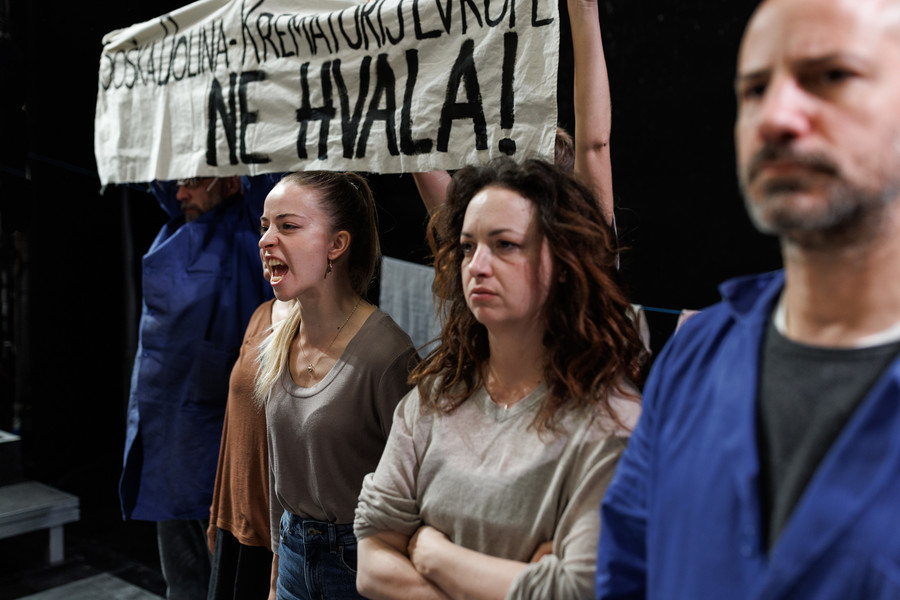
Katarina Morano & Žiga Divjak: Anhovo, photo by Matej Povše, SNG Nova Gorica
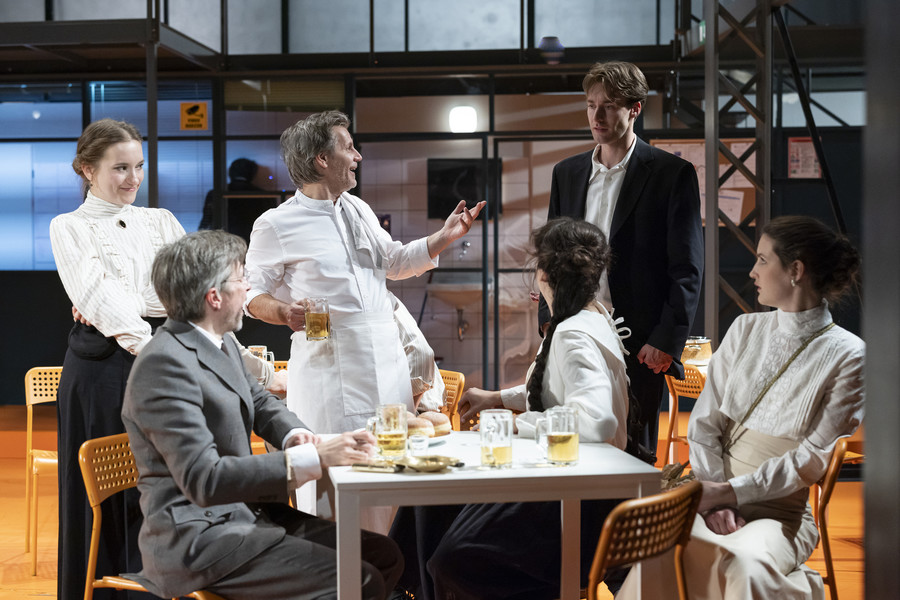
Ivan Cankar, Varja Hrvatin, Bor Ravbar: And Many Others…, photo by Jaka Babnik, SLG Celje & PG Kranj